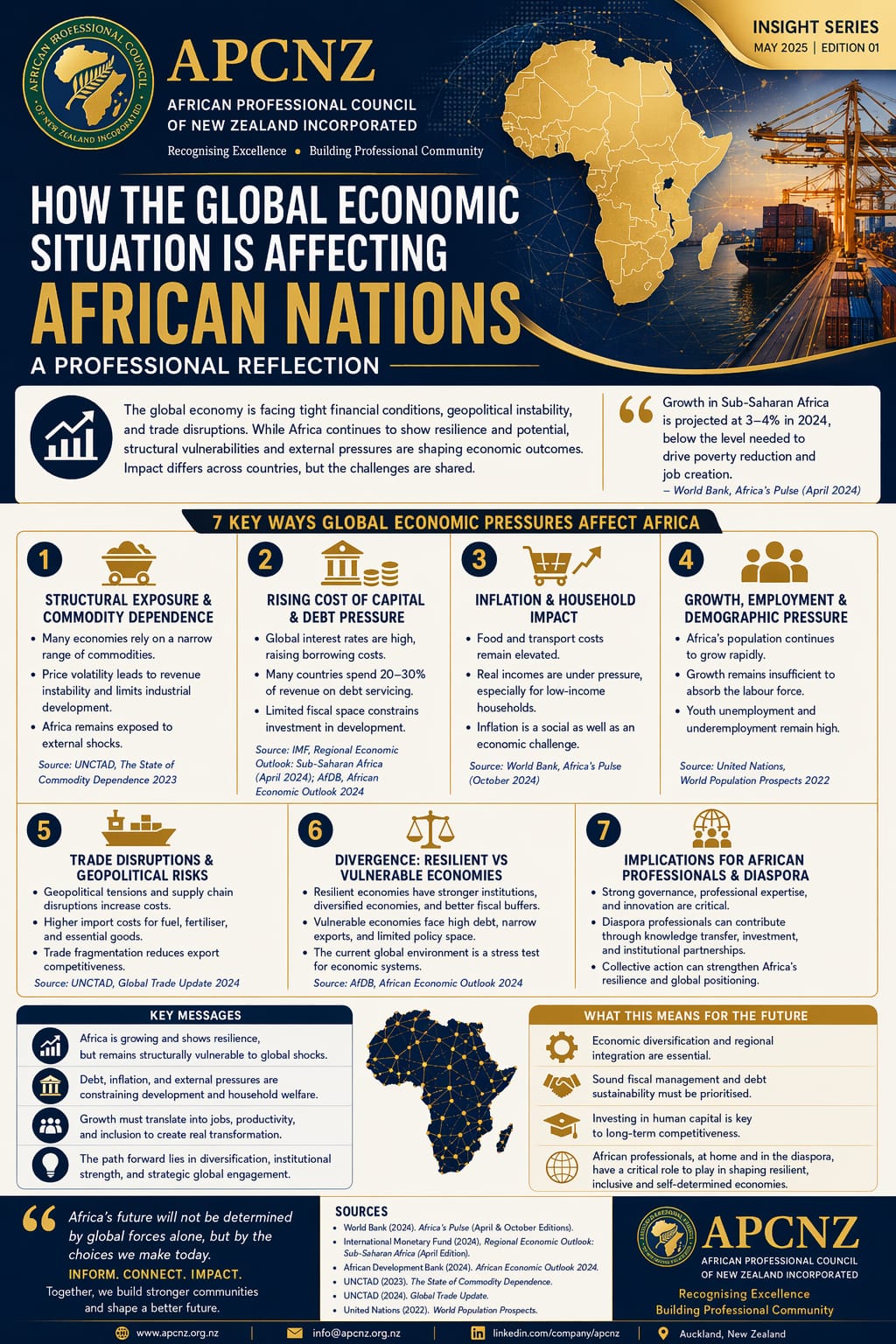
How the Global Economic Situation Is Affecting African Nations: A Professional Reflection
African Professional Council of New Zealand Incorporated (APCNZ)
Recognising Excellence | Building Professional Community
Author: APCNZ Contributor
Author’s Note
This article presents an informed professional reflection on current global economic pressures and their implications for African nations. It does not constitute a formal policy position of APCNZ, nor is it intended as a peer-reviewed academic paper. It draws on recent global economic reports to support a structured professional analysis.
Introduction
The global economic environment is currently characterised by tight monetary conditions, geopolitical fragmentation, and uneven global growth. According to the World Bank (Africa’s Pulse, April 2024), growth across Sub-Saharan Africa is projected at approximately 3–4%, a rate that remains below the level required to significantly reduce poverty or absorb labour force growth.
It is analytically important to distinguish between different African economies. For example:
Oil-exporting economies such as Nigeria may benefit from higher energy prices
Import-dependent economies such as Kenya face inflationary pressure from rising global costs
Reform-oriented economies like Rwanda have demonstrated stronger institutional resilience
The global economic situation therefore does not impact Africa uniformly, but it does impose shared structural constraints.
- Structural Exposure and Commodity Dependence
A key feature of many African economies is commodity dependence. According to UNCTAD (The State of Commodity Dependence 2023), a large proportion of African countries remain reliant on primary commodity exports, often with limited value addition.
This creates a dual vulnerability:
Revenue volatility when commodity prices fluctuate
Limited domestic industrial development
As noted in the report, commodity-dependent economies face greater exposure to external shocks, reinforcing structural inequality within global trade systems.
- The Rising Cost of Capital and Debt Pressure
Global financial tightening has significantly affected African economies. The International Monetary Fund (Regional Economic Outlook: Sub-Saharan Africa, April 2024) highlights that borrowing costs have increased alongside tighter global liquidity conditions.
At the same time:
Several African countries now allocate over 20–30% of government revenue to debt servicing
External financing conditions have become more restrictive
The African Development Bank (African Economic Outlook 2024) similarly emphasises that rising debt vulnerability is constraining fiscal space and limiting development expenditure.
- Inflation and Household Impact
Inflation remains a critical concern across many African economies. According to the World Bank (Africa’s Pulse, October 2024), food inflation has remained persistently high in several countries, disproportionately affecting low-income households.
In practical terms:
Food and transport costs consume a significant share of household income
Real wages often lag behind price increases
Urban populations face heightened exposure
This reinforces the point that inflation is not only a macroeconomic indicator but a social and economic pressure with direct implications for household stability.
- Growth, Employment, and Demographic Pressure
Africa’s demographic trajectory presents both opportunity and challenge. The United Nations (World Population Prospects 2022) projects that Africa’s population will continue to grow rapidly, placing increasing pressure on labour markets.
However:
Current growth rates remain insufficient to generate adequate employment
Youth unemployment and underemployment persist across many economies
The challenge lies not only in achieving growth, but in ensuring that growth is inclusive, labour-absorbing, and
productivity-enhancing.
- Trade and Geopolitical Disruptions
Global trade dynamics are increasingly shaped by geopolitical tensions and supply chain disruptions. The UNCTAD (Global Trade Update 2024) notes that developing economies face rising shipping costs and increasing trade fragmentation.
For African nations, this results in:
Higher import costs for fuel and fertiliser
Supply chain disruptions
Reduced competitiveness in export markets
While frameworks such as the African Continental Free Trade Area aim to strengthen intra-African trade, implementation challenges remain.
- Divergence: Resilient vs Vulnerable Economies
A more precise analytical distinction is between resilient and vulnerable systems.
Resilient economies tend to demonstrate:
broader revenue bases
stronger institutional frameworks
diversified production structures
Vulnerable economies often face:
high external debt exposure
limited fiscal buffers
narrow export profiles
The current global environment acts as a stress test, revealing the degree to which economies can absorb external shocks.
- Implications for African Professionals and the Diaspora
For African professionals, including those within APCNZ, these dynamics carry strategic implications.
Areas of increasing importance include:
governance and institutional strengthening
financial and legal expertise
cross-border investment facilitation
knowledge transfer and capacity building
Diaspora professionals are uniquely positioned to contribute through:
advisory roles
institutional partnerships
professional networks that bridge global and local systems
Conclusion
In this analysis, the global economic situation is affecting African nations not merely by influencing growth rates, but by exposing underlying structural vulnerabilities.
Reports from the World Bank, International Monetary Fund, and African Development Bank consistently highlight a central issue:
many African economies remain more exposed to global economic shifts than influential within them.
Addressing this imbalance requires sustained focus on:
*economic diversification
*institutional strength
*fiscal resilience
*human capital development
For APCNZ and its members, this is not only an analytical issue but a matter of professional relevance and long-term strategic engagement.
References
*World Bank (2024). Africa’s Pulse (April & October Editions)
*International Monetary Fund (2024). Regional Economic Outlook: Sub-Saharan Africa (April Edition)
*African Development Bank (2024). African Economic Outlook 2024
*UNCTAD (2023). The State of Commodity Dependence
*UNCTAD (2024). Global Trade Update
United Nations (2022). World Population Prospects